
Wednesday, December 16, 2009
APLM Colloquium 2008
At the inaugural APLM Colloquium in November 2008, the Rev. Dr. Paul Bradshaw spoke on the topic “The Liturgical Movement: Gains and Losses.” Dr. Bradshaw has taught at the University of Notre Dame since 1985 and is acknowledged as one of the foremost liturgical scholars not only in the Anglican Communion, but throughout the Christian world. He has also published extensively on the subject of Christian liturgy, having written or edited more than 20 books and over 90 essays or articles. His major books include Daily Prayer in the Early Church, The Search for the Origins of Christian Worship, and Eucharistic Origins.

Tuesday, December 8, 2009
A Priestly Offering: Intercessory Prayer in Christian Worship
Above is the video of the Associated Parishes Colloquium at Church Divinity School of the Pacific. The second Associated Parishes for Liturgy and Mission Colloquium took place on November 12, 2009, at Church Divinity School of the Pacific, Berkeley, CA. Featured speaker the Rev. Dr. Ruth Meyers spoke on the topic “A Priestly Offering: Intercessory Prayer in Christian Worship.” After a formal response by Dr. John Klentos, lively Q-and-A and conversation ensued. A video of the talk will be linked at this website when it becomes available.
In July 2009, Dr. Meyers began serving as Hodges-Haynes Professor of Liturgics at Church Divinity School of the Pacific, after 14 years on the faculty of Seabury-Western Theological Seminary, Evanston, Illinois. Her publications include Continuing the Reformation: Re-Visioning Baptism in the Episcopal Church, Gleanings: Essays on Expansive Language with Prayers for Various Occasions (edited with Phoebe Pettingell), and numerous articles and book reviews. She was recently elected chair of the Episcopal Church’s Standing Commission on Liturgy and Music. A past president of North American Academy of Liturgy, Dr. Meyers has also served on the Steering Committee of the International Anglican Liturgical Consultation, in which she continues to be an active participant. Her current research focuses on the relationship of liturgy and mission.
Respondent John Klentos is Associate Professor of Eastern Orthodox Christian Studies, Patriarch Athenagoras Orthodox Institute, Graduate Theological Union, Berkeley, California. Dr. Klentos, a graduate of the University of Notre Dame, has published several articles on Orthodox worship and theology. His research interests include the history of Byzantine liturgy and Orthodox Christian theology.
At the inaugural APLM Colloquium in November 2008, the Rev. Dr. Paul Bradshaw spoke on the topic “The Liturgical Movement: Gains and Losses.” Dr. Bradshaw has taught at the University of Notre Dame since 1985 and is acknowledged as one of the foremost liturgical scholars not only in the Anglican Communion, but throughout the Christian world. He has also published extensively on the subject of Christian liturgy, having written or edited more than 20 books and over 90 essays or articles. His major books include Daily Prayer in the Early Church, The Search for the Origins of Christian Worship, and Eucharistic Origins.
Friday, November 27, 2009
Confirmation

Recently on the Associated Parishes email list for the council list we got into a discussion of Confirmation that began because Ruth Meyers discovered an Executive Council Resolution calling for the development of competancies for Confirmation.
The idea that Confirmation is in any way required for full inclusion in the life of the church is antithetical to what we stand for, and "competancies" seem to imply that one is not a full member until the confirmation box is checked. Yet, some of us wondered if the best way to attack that implication might not include a recognition that the drive for "competancies" may come from a valuable goal of ensuring the quality of Christian Formation programs in local churches - which logically flows from taking the Baptismal vows seriously.
How can "Confirmation" be understood and practiced in such a way that Baptismal theology is not undermined? Though the BCP seems clear to us, Confirmation is misunderstood on the ground in many places. Is it too misunderstood to be salvaged as a practice or should the practice of "Confirmation" as it is now, be ended so that it will be clear to all that the chrismation at the end of the baptism seals the individual and completes the Baptism? Our long discussion has included varying viewpoints on whether teens can be thought of as "mature" enough to be expected to make the commitment of Confirmation, among other things.
Ruth rightly noted yesterday that as we had moved into a general conversation about Confirmation we ought to move the conversation over to the ap members list and the APLM blog. So I'm attempting to do that and offer the things that are beginning to crystalize for me... (sorry this is long but...)
Remembering an earlier conversation on this listserv I pondered the various reasons and meanings that others had given to the presence of the bishop at Confirmation. The presence of the bishop seems to be a key issue/problem in this whole debate. I began to connect that with my current situation in my parish.
I am currently involved in leading a YAC group (the final portion of the Journey to Adulthood program in which Confirmation is often expected to occur) and so the question of Confirmation, - its rationale, its theology, etc, are hitting me where I live. I do not think that the group I am working with has recieved all that they should have formationally and educationally for me to believe it is appropriate to present them for Confirmation and am doubtful that we can accomplish this by the scheduled date for our "Durham area" Confirmation (note this is not a parish event) in April.
Particularly, while they have learned many good things through J2A about getting along and serving the less fortunate, they do not demonstrate the slightest ability to connect the tradition (liturgy or scripture or any theolgical concept or any spiritual practice) with their lives or their ethical views about helping others.
While I realize that many adults also can not do this, I have seen 10 and 11 year olds demonstrate better theological and liturgical literacy. The parish I was in from 1996 until a year ago has led me to believe that a pretty high level of theological competance can be developed by the teenage years in many children if we aim high. I suggested that perhaps the competancies for confirmation, if developed and carefully worded, could actually reflect more on the parish and its program of formation, and thus be used to reinforce Baptismal theology and the liturgical "We will" that is part of the rite.
If I decide to refuse to present the youth for Confirmation my reason will be that "WE are not ready" - we, the parish, have not completed what we ought to have formed in these kids by this point in their lives. I am beginning to form the following position: Whether the parish is marking a period of preparation that coincides with the time when a child is entering the wider world (indicated by things that teens are usually doing: driving, working, preparing for college or the military) or marking a moment when an adult who was baptised as an infant, has come formward expressing a desire to make an adult commitment to the baptismal vows, it seems to me that the bishop's presence can be understood in a way that some have recently expressed.
The bishop signifies the connection to the wider church and the world - appropriate for times when a person is either about to venture out, is currently in a typically more transient time of life or has settled into a parish after a time of normal transience (college, etc). And the bishop's presence, if understood in this way, could also signify his or her validation of the parish's work in preparing individuals for a mature (though admittedly varying levels of "mature") profession of faith, which, in my view, includes the understanding that the baptismal call is not limited to life between the parish walls. In other words, the parish has attended to the "we will" of the baptism.
In the case of teens, they send the youth out knowing they have done what was in their power to support the child in their life in Christ. OR in the case of adults they are owning the "we will" that others made in an earlier time and usually in a different space. In no way would Confirmation be confused as a requirement for life in the church; it would merely mark a time of intentional preparation and reflection on one's baptismal call that is the result of participation in the church. Whew - that's a lot, but there was a LOT more over the last few days... we should have moved this over sooner!
I'm sure the other council members will now summarize what they feel is at the fore of this issue... and I'm excited about hearing many voices on these issues- especially those who will disagree with me!
-Celeste
Friday, September 4, 2009
Speaking the Call to Ministry to One Another

Speaking the Call to Ministry to One Another: A re-visioning of the Chrism Mass Holy Week liturgy, with bishop, clergy, and laypeople. Where might we go with the Maundy Thursday Chrism Mass and Reaffirmation of Ordination Vows? Donald Schell writes of twenty-five years experience of the ‘Chrism Mass’ and Renewal of Ordination Vows in Holy Week, valuing the experience for its collegiality and but also wondering how diocesan and cathedral liturgies for this event, shaped when the 1979 Prayer Book was new, could be reframed to give clergy and laity in Holy Week opportunity to celebrate and nurture their shared call to service and the servanthood in friendship that Christ commands in John’s Gospel.
Wednesday, August 19, 2009
Starting from Scratch

Starting from Scratch: What Church Panting Looked Like for St. Lydia's is a new Open article now online. Click the image above to read the article by Emily Scott.
Emily Scott tells of the first months of founding St. Lydia’s, her new effort at liturgical evangelism and community building with young adults in New York City. The congregation that she began and that’s now taking steps to shape its own life is still, as she says, ‘hot off the press,’ and she tells the beginning of a story that invites us to ask for more.
Here as St. Lydia’s is just begun and while the thinking and experience are in formative stages she writes about what prompted this beginning, how she made initial choices, what church and organizational thinking she drew on to shape a new start-up. With the unguarded voice of those moments of beginnings, she’s asking what the work of starting something really is. That question of how to begin something new can speak to any church leader and any congregation. It’s always going to be specific and local, anyone risking the spiritual and practical work of first steps will welcome hear not just of the progress St. Lydia’s has made, but how that progress was made, and what they learned along the way.
Anticipated Returns: The Advent Project

Anticipated Returns: The Advent Project is a new Open article. Click the image above to read the article by William Peterson.
We publish Bill Petersen’s article on the North American Academy of Liturgy’s “Advent Project Seminar” in time to challenge any of us who plan liturgy to restore Advent to its ancient seven week length, sidestep the ‘Christmas culture,’ and find our way to much-needed preaching, teaching and reflection on what Christian eschatology actually looks like, how it’s different from ‘End Times’ speculations of the Religious Right, and how the end which has come to us in Christ invites us to live differently NOW. The North American Academy of Liturgy’s ecumenical conversations took this renewed approach to practical ideas including the observation that the Revised Common Lectionary anticipates such a change, or at least supplies suitable readings for a seven week Advent. The seminar also suggested experimental use of the “O” Antiphons one by one for this longer seven week Advent, and invited making new sources (or adapting existing ones) such as hymnody and psalm antiphons to give the extended season character and life. This article was invited by APLM Council member John Hill and is also published in Liturgy Canada.
Read it and see what your congregation can do to linger in reflection on the coming and presence of God’s kingdom. The seminar is particularly interested in hearing of experiments this advent – what you tried and how it worked. Read, ponder, and join this ecumenical and international effort to renew and enlarge our Advent in practice.
Pews, Mission, and Worship

Pews, Mission, and Worship: A Pastoral Letter to a Parish is a new Open article now online in PDF format. Click the image here to read Philip Carr-Janes article.
Writing a pastoral letter to his congregation about the history of church furniture (particularly the seating) and what it can do to serve or hinder or worship, Phil Carr-Jones gives broad Biblical background, a solid sketch of the history and evolution (or decay) or Christian practice and proposes a full seasonal cycle for reordering the church space with a rationale for the seating of each season.
Saturday, July 11, 2009
Baptismal Theology Resolution

The following Resoltion B013 was passed by The General Convention of The Episcopal Church to continue the work APLM is leading on Baptismal Theology:
Resolved, the House of _______ concurring, That the 76th General Convention of The Episcopal Church commend the Presiding Bishop for convening, with Associated Parishes for Liturgy and Mission, a national consultation on baptismal theology in October 2007, representative of bishops, theologians, liturgists, Christian educators, parish priests and justice advocates and inclusive of the diversity of this Church; and be it further
Resolved, That the 76th General Convention further commend the national baptismal theology consultation for identifying areas and resources needed to implement fully the baptismal theology of the Book of Common Prayer in the life of the Church; and be it further
Resolved, That the 76th General Convention commend the Theology Committee of the House of Bishops and the Colloquium of North American Anglican Liturgists for their meeting in January 2008, for identifying together the needs of the Church in ongoing baptismal formation and ministry and formation in Episcopal identity; and be it further
Resolved, That the 76th General Convention urge the national consultation on baptismal theology to continue its work in the next triennium and provide to the next General Convention educational resources for formation in Episcopal identity and rites to celebrate that identity, educational resources for training the baptized for leadership positions in the Church and rites for entering leadership positions, and any proposed revisions to the canons to conform them to the baptismal theology of the Book of Common Prayer.
EXPLANATION
The 75th General Convention in 2006 considered resolutions from the Dioceses of Connecticut, Northern Michigan, and California which called for conforming the Canons to the baptismal theology of the Book of Common Prayer. The cognate Committees on Liturgy and Music of the respective houses expanded the original diocesan resolutions to call for a national consultation on baptismal theology representative of bishops, theologians, liturgists, Christian educators, parish priests and justice advocates and inclusive of the diversity of the Church. The consultation was to prepare educational resources for formation in Episcopal identity, training programs for certification for leadership positions in the Church, and any revisions to the Canons to conform them to the theology of the Prayer Book. While Convention did not complete action on that resolution, the Presiding Bishop, working with Associated Parishes for Liturgy and Mission, convened a national consultation on baptismal theology in October 2007 that met the composition of the resolution. An agenda was identified to accomplish the work and task forces created to accomplish it. In January 2008, Bishop Henry Parsley and other members of the Theology Committee of the House of Bishops met with the Colloquium of North American Anglican Liturgists to identify the needs of the Church to implement the Prayer Book's baptismal theology. The national consultation on baptismal theology needs to continue its work in the next Triennium and bring its resources and recommendations to the 77th General Convention in 2012.
Prayers for The General Convention
Prayers for the Daily Offices and Occasions of General Convention 2009
Jennifer Phillips (Clergy- Alt.1, RI)
1.
From West and North and East and South
we gather to do you honor, Blessed God.
We thank you for one another,
for the gracious earth that sustains us,
for the vision of your coming reign,
and for the love of the Savior, Jesus Christ,
through whom you have stooped to lift us
and the whole world heavenward,
and who with you and the Holy Spirit
is one God, to the ages of ages. Amen.
2.
Vigilant God, whose ears are always open to your people’s cry:
hear the plea of those who are poor and in distress;
attend to those whose clamor is for justice
and whose lament seeks comfort and reconciliation.
May your Spirit shape us into people of long listening
and patient understanding toward one another,
generous of heart, leavened by humor, truthful in speech
and kindly in intent;
and grant us a share of that mind which was in Christ our Savior
who called us friends,
and in whose name we ask it. Amen.
3.
God whose cresting hand
has quilted us into one fabric,
one pattern of beauty and right proportion for you pleasure:
teach us so to rejoice in one another
and to blend our wills in common purpose
that together we may warm the world with love,
serving your whole creation well
in the name of Jesus Christ
and by the energy of your Holy Spirit. Amen.
4.
Wisdom cries out at the gates:
let those who seek to discern wisely
sit and reason together in my presence!
And so, Holy One, we join in council here.
In the urgent concerns and in the clutter of our agendas,
may your Wisdom be our guide,
that we may love kindness, do justice,
and in humility desire only you;
we pray in the name and through the Spirit
of Jesus, the Beloved. Amen.
5.
Praise to you, Holy One!
You shower us with blessing
like grain poured out into our lap in full measure,
shaken down, running over.
Stir up in us such joy and goodness
that all whom we encounter
may see and know by our lives
that your reign has come near them;
this we pray through Jesus Christ our Savior,
who with you and the Holy Spirit
lives and reigns one God, now and for ever. Amen.
6.
Bountiful God,
before whom we stand in the poverty of our being,
which by your plentiful redemption becomes rich and full of blessing;
so draw us into habits of generosity and mercy
that, filled with thankfulness,
we may be mindful of all those who live in need or distress
and may love these others as you first loved us,
that we may walk in the footsteps of our Savior Jesus Christ
who with you and the Holy Spirit,
is one God living and true, to the ages of ages. Amen.
7.
All-Holy and Life-Giving God,
whose Spirit summoned the prophets into brave witness,
and dwelt in your Son Jesus, fully human and divine;
you poured out that same Spirit on the disciples
in Penetcost wind and fire, to flow into all your Church.
By the power of that Spirit given to us in Baptism,
send us continually into all your world
as glad messengers of the Gospel,
so that always and everywhere
we may honor you and give you praise,
Holy and undivided Trinity for ever and ever. Amen.
7.
God, our rock and refuge,
who for our restless hearts
are the only true rest and home:
teach us to be clement and welcoming
toward all who are strangers and sojourners,
all who travel for work or for safety,
all who migrate in fear and danger,
and all those who have no homes.
We pray in the name of your child Jesus
who saw the foxes in their dens and the birds on their nests
and yet had no place safely to lay his head,
but who welcomed us as heirs
and fellow-citizens of the reign of heaven,
where with you the Father, and the Holy Spirit,
risen and ascended he now dwells
with all the saints in light to the ages of ages. Amen.
8.
Invisible, almighty and eternal God
whose energy and order guides the atomic particles
and the planets in their dance:
deepen in us appreciation for our cosmos,
renew our joy in your goodness,
move us to respect and wonder at the mystery of your work
and grant us to be
prudent in conserving, temperate in using,
brave in self-restraining, generous in sharing,
and just in honoring every creature of yours in its own right
and for your sake,
that in all things we may honor you and give you praise. Amen.
9.
God whose desire for us will not be thwarted
when we lock ourselves away in fear:
your Christ comes to us through the walls we build,
filling us with peace and courage;
when we hide ourselves in the abyss,
even there your right hand holds us fast;
and when we wander in the greyfields of our sin,
you call us back
and your untiring love harrows hell to save us!
Give us grace, that even lying in the graves of our own devising,
we may stretch out our hands to be grasped by the strong arm
of our Savior, Jesus Christ,
and be raised with him by the power of the Holy Spirit
into eternal union with one another and with you,
who live and reign, one God, now and for ever. Amen.
10.
Let this be our green season,
God of the turning world and wheeling stars;
Fill us with the sweet fruitfulness of your love,
the urgency of the season to bring forth justice and joy.
Let the children play in the streets of the world safely,
and all the homes have open doors;
let the elders converse in peace on the porches
and the workers come home singing
over all your earth.
Let praise rise to you
like steam from the cooking fires
where all may be fed.
And let your Holy Spirit
and the life-bringing path of your Son Jesus,
draw the whole cosmos into perfect unity in you. Amen.
Occasional prayers for moments of stress, distress, particular thanksgiving, or special need:
Author of Life, whose Spirit comes to us
with the energy of wind and flame:
set us ablaze with passion to see your kingdom come;
fill us with your creative breath to help renew the face of the earth;
show us the brightness of your radiance in the faces
of all those whom you bring into being;
and by that same Spirit, move us always to say,
Thank you! Glory to you! Alleluia! and Amen!
Thank you! Glory to you! Alleluia! and Amen!
In the morning, Blessed God, our cry comes to you,
and at the noon hour we send our voice
seeking your mercy and forgiveness.
Again and again we wound one another
and step from the path of what is just and right;
Again and again in our narrow vision and self-preoccupation
we pass by and disregard our neighbor in need;
And still you love us and draw us back
with the nail-imprinted hands of your mercy
and wiping the soil of sin off us
call us your own beloved children:
sisters and brothers of Jesus and heirs with him
of your eternal promises.
All thanks and praise to you,
holy and undivided Trinity, one God
for ever and ever. Amen.
How is it that you could make and love me
even as you have made and love my enemy?
How is it that your creation contains such a wild diversity
of life and form and climate?
What were you thinking, mysterious God…
and what are you thinking now?
Surely, that divine delight has endless iterations,
that your work is many-splendored, your goodness ever-new,
and your love playful, fierce and inexhaustible!
And surpassing all -- your love poured out for the world
in the mortal life and death of Jesus the Messiah!
You come so near us, Blessed and Blessing One,
small as we are,
and so we praise and thank you through that same Jesus Christ
who, with you and the Holy Spirit, live and reigns
one God, now and for ever. Amen.
Source of all being, Sustainer of all that lives:
the sound of your reverberant creating word
travels still through the universe making your love manifest.
How wonderful and beyond our knowing, most holy God,
is your grace and goodness toward us and all that you have made!
The whole cosmos cries Glory!
and we, your people, give our thanks and praise.
From continent to continent we stretch our hands toward one another
and send our voices to you in the hymn of all creation
acknowledging you alone as the Holy One.
In the power of your Spirit,
in the name of our Redeemer Jesus Christ, we pray. Amen.
We are listening.
God known to us through the hubbub and buzz of business,
known to us in the voice of friend and stranger,
known to us in grief and in laughter,
known to us in the still center of our heart,
when the mind turns and returns and sees more clearly:
speak now, that all may hear. Amen.
Not a sparrow falls without your knowledge,
Even the hairs of our head are numbered;
You have said it, gracious God.
In our grief in trouble and in [the fear of] loss
we lift to you our prayers for ________
and remembering that you have engraved us,
every one, on the palms of your hands,
and that in life and death your right hand holds us fast
and we dwell in the light of your Holy Spirit
through the self-giving of our Savior Jesus Christ,
with you, one God, Lord of time and memory,
now and for ever. Amen.
Jennifer Phillips (Clergy- Alt.1, RI)
1.
From West and North and East and South
we gather to do you honor, Blessed God.
We thank you for one another,
for the gracious earth that sustains us,
for the vision of your coming reign,
and for the love of the Savior, Jesus Christ,
through whom you have stooped to lift us
and the whole world heavenward,
and who with you and the Holy Spirit
is one God, to the ages of ages. Amen.
2.
Vigilant God, whose ears are always open to your people’s cry:
hear the plea of those who are poor and in distress;
attend to those whose clamor is for justice
and whose lament seeks comfort and reconciliation.
May your Spirit shape us into people of long listening
and patient understanding toward one another,
generous of heart, leavened by humor, truthful in speech
and kindly in intent;
and grant us a share of that mind which was in Christ our Savior
who called us friends,
and in whose name we ask it. Amen.
3.
God whose cresting hand
has quilted us into one fabric,
one pattern of beauty and right proportion for you pleasure:
teach us so to rejoice in one another
and to blend our wills in common purpose
that together we may warm the world with love,
serving your whole creation well
in the name of Jesus Christ
and by the energy of your Holy Spirit. Amen.
4.
Wisdom cries out at the gates:
let those who seek to discern wisely
sit and reason together in my presence!
And so, Holy One, we join in council here.
In the urgent concerns and in the clutter of our agendas,
may your Wisdom be our guide,
that we may love kindness, do justice,
and in humility desire only you;
we pray in the name and through the Spirit
of Jesus, the Beloved. Amen.
5.
Praise to you, Holy One!
You shower us with blessing
like grain poured out into our lap in full measure,
shaken down, running over.
Stir up in us such joy and goodness
that all whom we encounter
may see and know by our lives
that your reign has come near them;
this we pray through Jesus Christ our Savior,
who with you and the Holy Spirit
lives and reigns one God, now and for ever. Amen.
6.
Bountiful God,
before whom we stand in the poverty of our being,
which by your plentiful redemption becomes rich and full of blessing;
so draw us into habits of generosity and mercy
that, filled with thankfulness,
we may be mindful of all those who live in need or distress
and may love these others as you first loved us,
that we may walk in the footsteps of our Savior Jesus Christ
who with you and the Holy Spirit,
is one God living and true, to the ages of ages. Amen.
7.
All-Holy and Life-Giving God,
whose Spirit summoned the prophets into brave witness,
and dwelt in your Son Jesus, fully human and divine;
you poured out that same Spirit on the disciples
in Penetcost wind and fire, to flow into all your Church.
By the power of that Spirit given to us in Baptism,
send us continually into all your world
as glad messengers of the Gospel,
so that always and everywhere
we may honor you and give you praise,
Holy and undivided Trinity for ever and ever. Amen.
7.
God, our rock and refuge,
who for our restless hearts
are the only true rest and home:
teach us to be clement and welcoming
toward all who are strangers and sojourners,
all who travel for work or for safety,
all who migrate in fear and danger,
and all those who have no homes.
We pray in the name of your child Jesus
who saw the foxes in their dens and the birds on their nests
and yet had no place safely to lay his head,
but who welcomed us as heirs
and fellow-citizens of the reign of heaven,
where with you the Father, and the Holy Spirit,
risen and ascended he now dwells
with all the saints in light to the ages of ages. Amen.
8.
Invisible, almighty and eternal God
whose energy and order guides the atomic particles
and the planets in their dance:
deepen in us appreciation for our cosmos,
renew our joy in your goodness,
move us to respect and wonder at the mystery of your work
and grant us to be
prudent in conserving, temperate in using,
brave in self-restraining, generous in sharing,
and just in honoring every creature of yours in its own right
and for your sake,
that in all things we may honor you and give you praise. Amen.
9.
God whose desire for us will not be thwarted
when we lock ourselves away in fear:
your Christ comes to us through the walls we build,
filling us with peace and courage;
when we hide ourselves in the abyss,
even there your right hand holds us fast;
and when we wander in the greyfields of our sin,
you call us back
and your untiring love harrows hell to save us!
Give us grace, that even lying in the graves of our own devising,
we may stretch out our hands to be grasped by the strong arm
of our Savior, Jesus Christ,
and be raised with him by the power of the Holy Spirit
into eternal union with one another and with you,
who live and reign, one God, now and for ever. Amen.
10.
Let this be our green season,
God of the turning world and wheeling stars;
Fill us with the sweet fruitfulness of your love,
the urgency of the season to bring forth justice and joy.
Let the children play in the streets of the world safely,
and all the homes have open doors;
let the elders converse in peace on the porches
and the workers come home singing
over all your earth.
Let praise rise to you
like steam from the cooking fires
where all may be fed.
And let your Holy Spirit
and the life-bringing path of your Son Jesus,
draw the whole cosmos into perfect unity in you. Amen.
Occasional prayers for moments of stress, distress, particular thanksgiving, or special need:
Author of Life, whose Spirit comes to us
with the energy of wind and flame:
set us ablaze with passion to see your kingdom come;
fill us with your creative breath to help renew the face of the earth;
show us the brightness of your radiance in the faces
of all those whom you bring into being;
and by that same Spirit, move us always to say,
Thank you! Glory to you! Alleluia! and Amen!
Thank you! Glory to you! Alleluia! and Amen!
In the morning, Blessed God, our cry comes to you,
and at the noon hour we send our voice
seeking your mercy and forgiveness.
Again and again we wound one another
and step from the path of what is just and right;
Again and again in our narrow vision and self-preoccupation
we pass by and disregard our neighbor in need;
And still you love us and draw us back
with the nail-imprinted hands of your mercy
and wiping the soil of sin off us
call us your own beloved children:
sisters and brothers of Jesus and heirs with him
of your eternal promises.
All thanks and praise to you,
holy and undivided Trinity, one God
for ever and ever. Amen.
How is it that you could make and love me
even as you have made and love my enemy?
How is it that your creation contains such a wild diversity
of life and form and climate?
What were you thinking, mysterious God…
and what are you thinking now?
Surely, that divine delight has endless iterations,
that your work is many-splendored, your goodness ever-new,
and your love playful, fierce and inexhaustible!
And surpassing all -- your love poured out for the world
in the mortal life and death of Jesus the Messiah!
You come so near us, Blessed and Blessing One,
small as we are,
and so we praise and thank you through that same Jesus Christ
who, with you and the Holy Spirit, live and reigns
one God, now and for ever. Amen.
Source of all being, Sustainer of all that lives:
the sound of your reverberant creating word
travels still through the universe making your love manifest.
How wonderful and beyond our knowing, most holy God,
is your grace and goodness toward us and all that you have made!
The whole cosmos cries Glory!
and we, your people, give our thanks and praise.
From continent to continent we stretch our hands toward one another
and send our voices to you in the hymn of all creation
acknowledging you alone as the Holy One.
In the power of your Spirit,
in the name of our Redeemer Jesus Christ, we pray. Amen.
We are listening.
God known to us through the hubbub and buzz of business,
known to us in the voice of friend and stranger,
known to us in grief and in laughter,
known to us in the still center of our heart,
when the mind turns and returns and sees more clearly:
speak now, that all may hear. Amen.
Not a sparrow falls without your knowledge,
Even the hairs of our head are numbered;
You have said it, gracious God.
In our grief in trouble and in [the fear of] loss
we lift to you our prayers for ________
and remembering that you have engraved us,
every one, on the palms of your hands,
and that in life and death your right hand holds us fast
and we dwell in the light of your Holy Spirit
through the self-giving of our Savior Jesus Christ,
with you, one God, Lord of time and memory,
now and for ever. Amen.
Sunday, March 15, 2009
Meaning-to-someone
A Buddhist list serve sent this to me today, I think it speaks well to Juan's post:
–Thanissaro Bhikkhu, The Paradox of Becoming
We live in the same world, but in different worlds. The differences come partly from our living in different places. If you live to the east of a mountain and I to the west, my world will have a mountain blocking its sunrises, and yours its sunsets. But—depending on what we want out of the world—our worlds can also differ even when we stand in he same place. A painter, a skier, and a miner looking at a mountain from the same side will see different mountains.
–Thanissaro Bhikkhu, The Paradox of Becoming
Saturday, November 8, 2008
APLM Colloquium
The inaugural Associated Parishes for Liturgy and Mission Colloquium took place on November 6 at Church Divinity School of the Pacific, Berkeley, CA. The Rev. Dr. Paul Bradshaw was the featured speaker. Dr. Bradshaw has taught at the University of Notre Dame since 1985 and is acknowledged as one of the foremost liturgical scholars not only in the Anglican Communion, but throughout the Christian world. He has also published extensively on the subject of Christian liturgy, having written or edited more than 20 books and over 90 essays or articles. His major books include Daily Prayer in the Early Church, The Search for the Origins of Christian Worship, and Eucharistic Origins.
His topic for the address was "The Liturgical Movement: Gains and Losses." Dr. Bradshaw also sat in with students at a seminar for liturgical specialists, preached on William Temple on the latter's feast day, and delivered his address relating some of the history of the liturgical movement, with its successes and shortcomings, and finally answered many questions in both the closing part of the proceedings, and an informal questions thereafter.
A video of the talk will be linked at this website when it becomes available.
His topic for the address was "The Liturgical Movement: Gains and Losses." Dr. Bradshaw also sat in with students at a seminar for liturgical specialists, preached on William Temple on the latter's feast day, and delivered his address relating some of the history of the liturgical movement, with its successes and shortcomings, and finally answered many questions in both the closing part of the proceedings, and an informal questions thereafter.
A video of the talk will be linked at this website when it becomes available.
Monday, September 29, 2008
La Sacra Vida

The APLM Council will meet May 7-11, 2009 at the Mexican American Cultural Center in San Antonio. One major focus of this meeting will be inculturation. The Rev. James "Jake" Empereur, S.J. will be a presenter.
Jake is vicar and liturgist at the San Fernando Cathedral in San Antonio, Texas. He was for many years a professor of systematic and liturgical theology at the Jesuit School of Theology at Berkeley and the Graduate Theological Union. Reading his book La Sacra Vida: Contemporary Hispanic Sacramental Theology in advance will help participants to engage in the conversation at the meeting.
Look for more information to come at this website as we continue to plan for this meeting.
Sunday, September 7, 2008
The Baptismal Life

To live as a Christian is to live the baptismal life as it is expressed and experienced in the liturgy. It is in the liturgical context that the implications of the Gospel for contemporary life should be drawn out, through preaching and pastoral ministry. If the liturgy does not provide answers to contemporary questions, such as nuclear disarmament, world hunger, or abortion, it does provide the context in which these issues can be considered, and it proclaims the theological principles we must learn to apply to them.—Leonel L. Mitchell in Praying Shapes Believing
Monday, August 11, 2008
The Strength of Ritual

Episcopal Life has excerpted a column from the Rev. Patrick Malloy's book Celebrating the Eucharist: A Practical Ceremonial Guide for Clergy and Other Liturgical Ministers (Church Publishing, 2008). Malloy is the rector of Grace Church, Allentown, Pennsylvania, and has served on The Episcopal Church's Standing Commission on Liturgy and Music. The essay says in part,
Nothing is more important to the life of a community than what happens during that one hour on Sunday. At the most pragmatic level, the Sunday liturgy is the only time in the regular life of a community when everyone gathers.The full text of the Episcopal Life column, which also makes a thoughtful comparison to underground nuclear bomb testing in North Korea, is online here: The Strength of Ritual
From Sunday to Sunday, individual members of the community and subgroups within the community live out their particular vocations within the baptismal vocation. On Sunday, however, the body of Christ experiences itself in its totality. The Sunday Eucharist is a pivotal moment, both in the church's expression of what it is and in being formed into what it is.
If the Sunday liturgy is largely a clerical affair done by the priest for the people, so that the people are mere responders or observers rather than key actors, the chances that the parish will grow into a group of integrated, self-starting, empowered ministers is greatly decreased.
The liturgy will have expressed a worldview and simultaneously instilled a belief that "Father knows best" or "the priest has all the power" or "we lay people know how to take care of the nuts and bolts of this operation, but when it comes to God, that's better left to the professionals."
The liturgy is precisely common prayer, expressing and creating a common life. For the majority of the worshipping community, the liturgy's message is not easily resisted.
There always will be those in any Sunday assembly who are not members of the church, but seekers who have come hoping to find something that will give their lives meaning and direction. They are true participants, but they usually keep a safe distance, often literally, from the group. The Sunday Eucharist paints a picture for them of what the church is – or, more truly, what the church aspires to be.
It is not the only place they could explore the church. They could visit the parish soup kitchen and see the church as a force for social change and compassion. They could sit in on a midweek reading group and experience the church as a community of learning and exploration. They could observe the children's Sunday school and see the church as an agency that cares for the vulnerable and includes everyone, regardless of age.
At the Sunday Eucharist, though, all of what the seeker might see in any of those venues is on display at one moment. The Sunday assembly of the church is the most important moment in the church's relationship with itself and in its relationship with the world. Done well, ministering at the Sunday Eucharist facilitates the church's seeing and experiencing itself as the body it is growing into and, at the same time, showing the world an image of how human beings live when God's kingdom comes on earth as in heaven.
Ultimately, all of this depends on God. But, as the catechism says, the sacraments are means of grace, of an encounter with the Divine. They change people, and so they change the world, even on those normal days when hearts are not moved to conversion and worlds do not seem to be blowing up.
Monday, June 23, 2008
A Way and Style of Life
The APLM booklet Parish Eucharist says the following about the sending out that takes place at the conclusion of the liturgy and how this gets lived out in the week ahead:
It has been said that the most sacred moment in the Liturgy comes when the Body of Christ, having been fed by the Body of Christ, goes forth to be the Body of Christ in the world. We have been nourished by the Lord's Body and Blood, and now it is time to take up the Lord's life and work. We pause briefly to give thanks for the loving act of feeding us and to ask for guidance as we set out in mission....
The Liturgy is over, but the Eucharist is not. At the beginning of this booklet we observed that Eucharist is what the parish does. It is that...and more. It is the way the parish lives: thankfully, joyfully, as a participant in the resurrected life of Christ and servant to the world. That which we have just symboled in the Liturgy gets worked out in the day-to-day life of the parish and its members. That daily life, in turn, becomes the offering of our next liturgical celebration. Eucharist is a way and a style of life.

Wednesday, June 11, 2008
Celebrant as Intruder
—Robert Hovda, Worship, March 1990 (emphasis above in the authors)Any practice which communicates the notion that the leaders in public worship are "stars" is basically and desperately counterproductive, whether the leaders in question are clergy or musicians or any other ministers. Desirable gifts in the leader are no excuse. If her or his style in the particular role fails to communicate a sense of prayerful performance, of being (first of all) a worshipper and a member of a worshipping assembly, then he or she is not a leader but an intruder. And the gifts of such a one or such a group damage rather than enhance worship.

Wednesday, June 4, 2008
Buildings shape theology
the building always wins.
—Louis Weil
In his essay, "Rending the Temple Veil: Holy Space for Holy Community" for Church Publishing's book Searching for Sacred Space, Donald Schell writes,
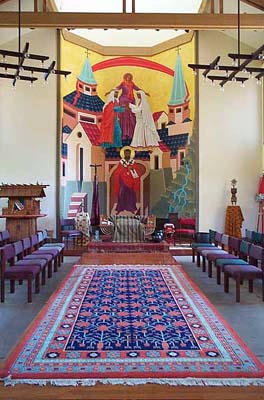
Today most Christian buildings shape our communities to a theology Jesus rejected. Christians who remember and want to live Jesus' teaching and practice must ask if the Middle Ages or even the Reformation or the Vatican II reforms offer us spaces for worship that are adequate to an authentic community and lively sacraments. Like it or not, the church building and furniture literally will shape the community's ways of gathering and the ways people will see one another. Brick and mortar theology, our walls, our furniture, and our seating will define relationships, lines of communication, and all the invisible dynamic aspects of community. Whether our church buildings appear loving, daring, inviting, or forbidding, each one holds a church community and defines how it can act or move.
Monday, June 2, 2008
Individualists are incapable of worship

The awesomely corporate act of public worship assumes, requires, demands a celebrating assembly of believing persons who have not lost the sense of being part of humanity, the sense of relation to, interdependence with, even identification with every other human being—as consequences of the love of God. People who approach that act, who gather on Sunday as self-contained unites, individuals for whom all others are merely competitors or makes, are simply incapable of it. Any sensitive pastoral minister has long since observed that the Sunday assembly's liturgical problems (participation, engagement, understanding, experience) cannot be solved by liturgical reforms alone.—The Rev. Robert Hovda, Worship, January 1991Of course the church needs continuing liturgical reform. The bed of a living tradition has to be dredged constantly, as a maxim has it. One of the glories of this confusing and promising century is the resumption of that invaluable service in so many parts of the faith communities of Judaism and Christianity. No question about it. Pressing those issues is a most important contribution to the life of faith.
But it is insufficient in itself. the cancer of Western and American individualism infects that Sunday assembly and produces as church that is barely capable of celebrating the eucharist or any other liturgical rite. We cannot blame the liturgy for the fact that we who celebrate it, the faith community, are so mesmerized by the idol of rugged individualism that it is dreamy to call us a "community" at all. It is quite impossible to see in our corporate life a community of biblical faith committed to witnessing in the world the advent of God's reign of justice and peace.

Thursday, May 22, 2008
Open, Spring 2008 Issue
 The Spring 2008 issue of Open is now online in Adobe PDF format.
In this issue of Open, “What is Baptism for?” is the organizing question, whether it is directly addressed by our authors or not. The gifts of the font in each of our lives reaches far beyond its immediate environs, and when a church community begins to really live out the power of God’s blessing in water, we all take note.
Articles including those on "Public Work" at St. Paul's Chapel in New York City, When Signs Signify by Louis Weil, Baptism or Confirmation? by Joe Morris Doss and an accompanying report by Robert Brooks, Against Inclusivity by Juan Oliver, and Going to Church in the First Century by Jamie Howison. The articles are listed below and this blog is intended to be a place where we can dialogue with the authors and one another on the ideas presented in the journal of the Associated Parishes for Liturgy and Mission.
Open: Good Liturgy at 9/11
 The Spring 2008 issue of Open includes the latest of Donald Schell's ongoing look at real stories of good liturgy.
 What might worship might look like that is a “Public Work” for pilgrims who visit the 9/11 memorial at St. Paul’s Chapel adjacent to Ground Zero in New York City? Donald Schell describes the power liturgy has to create meaningful connections between worshippers and visitors pouring off tour buses. The article is online here: Real Stories of Good Liturgy.
Subscribe to:
Posts (Atom)
